Sometimes the conversation is with each other.
Couples therapy can be a place to understand what keeps happening between you, talk about the things that have become difficult to talk about, and find different ways of relating to each other.
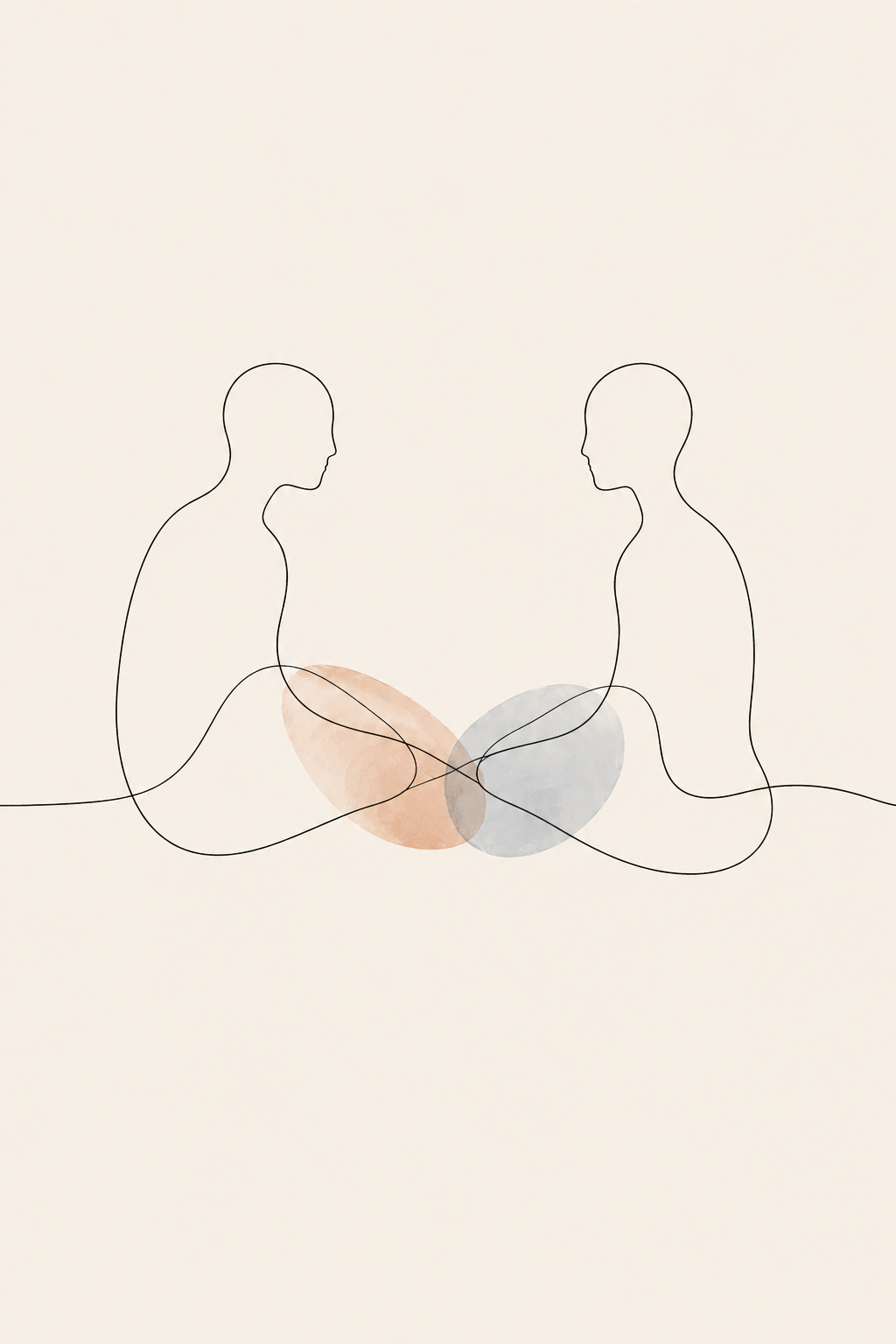
Couples come to therapy for all sorts of reasons.
Sometimes something has happened. Sometimes the same thing keeps happening. And sometimes nothing has happened at all – the relationship just doesn’t feel the way it used to.
Communication & conflict
Recurring arguments & patterns
Disconnection & intimacy
Infidelity & affair recovery
Trust & rebuilding
Sex & desire
Major decisions & life transitions
Parenting & family pressures
Separation & uncertainty about the relationship
Communication during & after separation
Keeping a good relationship strong
In couples therapy, the relationship is the focus. We look at what happens between you – the patterns you fall into, how conversations get stuck, what each of you brings to the interaction and what happens next.
The aim isn’t to decide who started it or who has the better argument. It’s to understand what keeps happening between you well enough to begin doing something differently.
It’s not about who’s right.
So, how do we change what keeps happening?
My approach to couples therapy is integrative, drawing on the Gottman Method, Emotionally Focused Couples Therapy and Integrative Sex and Couples Therapy, alongside contemporary thinking around intimacy, sexuality, connection and relationship dynamics.
The Gottman Method grew out of decades of research into what John and Julie Gottman described as the “Masters” and “Disasters” of relationships – observing thousands of couples to understand what those whose relationships remained strong were doing differently from those whose relationships struggled.
That research identified patterns in the way couples communicate, manage conflict, respond to each other and maintain friendship and connection over time. These findings inform practical, research-based strategies that can help us understand what’s happening between you and what might help things change.
In practice, that means we might look at how conflict unfolds between you, what sits underneath your reactions, how friendship and connection are functioning, or what happens when you try to talk about sex, intimacy, trust or other difficult things. We’ll work on understanding the pattern, but also on what you can actually do differently.
Understanding the pattern is one thing.
Changing what happens next is the work.
So, what do we actually do together?
We slow things down. We pay attention to what happens when a conversation starts to go off track. We work out what each of you is trying to say – and what the other person is actually hearing. We practise having difficult conversations differently, build skills for managing conflict and look at ways to strengthen friendship, connection and intimacy.
Want to go a little deeper?
The optional Gottman Relationship Checkup is a comprehensive assessment of 300+ questions, which each partner completes separately, at home and in their own time. It takes around an hour each.
It gives us a more detailed picture of what’s working, where you’re getting stuck and what may be happening underneath it. I review and interpret the results alongside what I learn about each of you during your individual sessions, giving us a richer understanding of the relationship and helping us focus our work on what matters most.